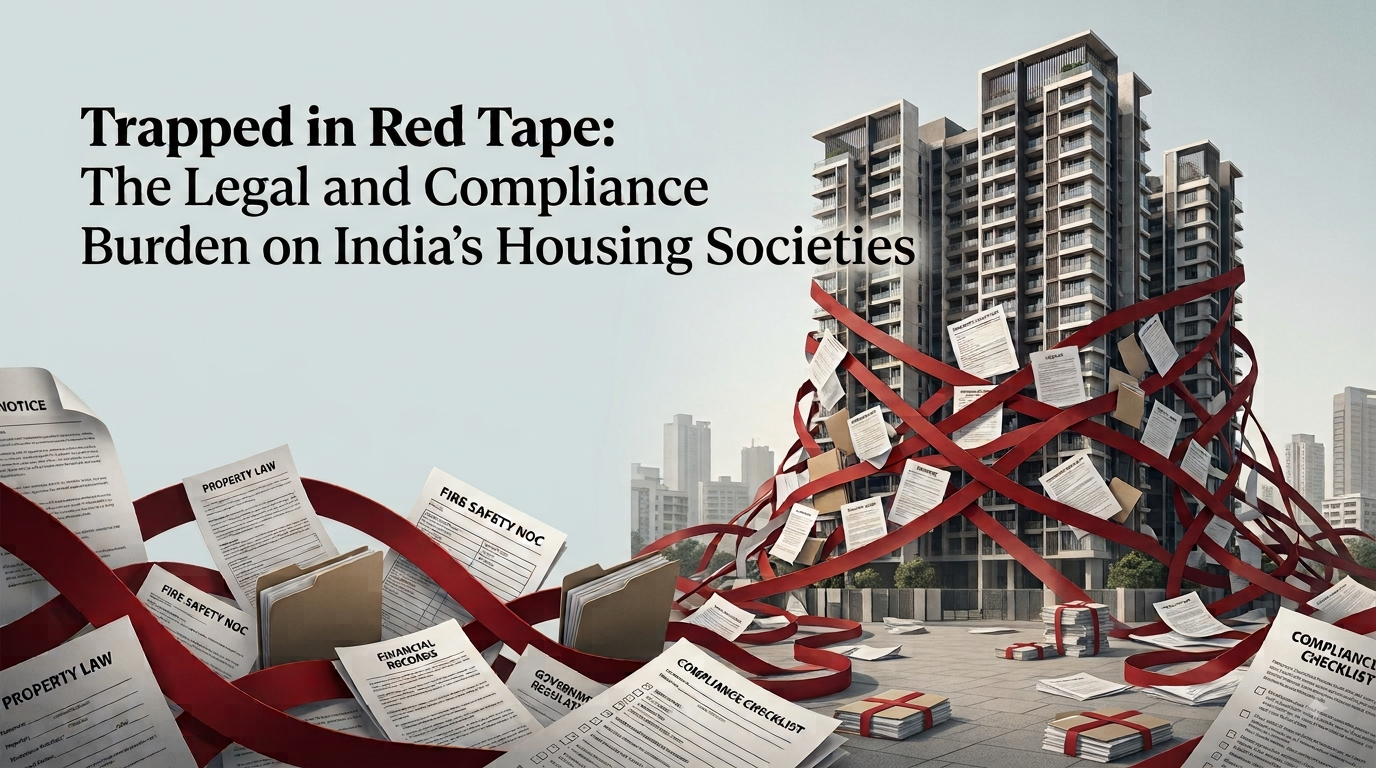
Trapped in Red Tape: The Legal and Compliance Burden on India’s Housing Societies
For Residents’ Welfare Associations and Apartment Owners Associations, managing a multi-story housing society is not just about fixing leaky pipes and cleaning corridors — it increasingly means navigating a complex, often punishing maze of legal obligations, government paperwork, and unresolved disputes with builders.
India’s multi-story residential buildings are home to millions, yet the associations tasked with managing them — RWAs and AOAs — operate under a weight of legal and compliance obligations that would strain even a professional legal team. These are volunteer-led bodies, often staffed by well-meaning residents with little formal knowledge of property law, government procedures, or regulatory frameworks. Yet the state holds them to the same standard as incorporated organisations. The consequences of non-compliance can be severe: fines, loss of essential services, safety risks, and paralysing disputes. This article examines each of the four major legal burdens these associations face — and what can realistically be done about them.
The Registration Renewal Trap
Every RWA or AOA must be formally registered — typically under the Societies Registration Act, 1860, or the relevant state cooperative housing society legislation. Registration is not a one-time formality. It demands regular renewals, annual filings, submission of audited accounts, updated lists of office-bearers, and adherence to state-specific procedural requirements that vary dramatically across India.
In practice, this becomes a recurring source of anxiety for association committees. A change in office-bearers, a missed AGM, a delayed audit — any of these can trigger a lapse in registration status. And a lapsed registration has cascading effects: the association may lose its legal standing to open bank accounts, sign contracts with vendors, or even take legal action against defaulting residents. In some states, an unregistered or lapsed RWA cannot collect maintenance dues through formal channels.
“Most RWA committee members are engineers, doctors, or retired professionals — not lawyers. Yet they are expected to track renewal deadlines, maintain statutory registers, file returns, and respond to government queries, often with no administrative support whatsoever.”
The paperwork itself is bewildering. Forms differ by state and are rarely available in a simplified or digital format. In several states, physical visits to government offices remain mandatory. Long queues, unhelpful counter staff, and demands for documents that weren’t listed in any official notice are common complaints. The burden falls disproportionately on the honorary secretary — a position that is unpaid, time-consuming, and increasingly difficult to fill.
There is also the problem of institutional memory. When committee members rotate — as they must — knowledge of renewal timelines, filing procedures, and document requirements is often lost. New committees inherit backlog without guidance, and lapses accumulate silently until a crisis forces attention.
A Bureaucratic Labyrinth Without a Map
Beyond registration, RWAs and AOAs are required to comply with a growing body of government mandates — many of which are poorly communicated, inconsistently enforced, and not designed with voluntary associations in mind.
Tax Filings & GST
Associations collecting maintenance charges above certain thresholds must register for GST and file regular returns. Many are unaware of this obligation until they receive a notice — or worse, a penalty.
Labour Law Obligations
Employing security guards, housekeeping staff, or maintenance personnel triggers obligations under the Contract Labour Act, PF and ESI regulations, and minimum wage laws — all requiring regular filings and inspections.
Electricity Load Sanctions
Adding new amenities — EV charging, upgraded lifts, additional lighting — requires fresh load sanctions from the electricity board, a process involving technical documentation, site inspections, and long waiting periods.
Fire NOC Renewals
Fire No-Objection Certificates must be renewed periodically. The renewal process often requires re-inspection, documentation of fire equipment, and in many cases, significant upgrades to existing systems.
Elevator NOCs
Lifts must be inspected and certified annually under the respective state’s Lifts and Escalators Act. Non-compliance means the lift must be shut down — a major inconvenience in high-rise buildings, particularly for elderly and disabled residents.
Environmental Compliance
Larger societies may face obligations around rainwater harvesting, solid waste management, and sewage treatment plant maintenance — each governed by different municipal or state-level bodies with separate compliance requirements.
The challenge is not merely the volume of compliance requirements — it is their fragmented nature. Different obligations fall under different government departments: the Registrar of Societies, the GST department, the Electrical Inspectorate, the Fire Department, the Municipal Corporation, and labour authorities. There is no single window, no unified checklist, and no proactive communication from any of these bodies. Associations must discover their obligations independently, often through costly mistakes.
The irony is stark: the government expects RWAs and AOAs to function as well-administered quasi-corporate entities while providing them with almost no structured support, training, or simplified access to the very compliance systems they must navigate. The result is widespread non-compliance — not from negligence, but from genuine lack of awareness and capacity.
A single, state-level compliance portal for housing societies — aggregating all filing requirements, deadlines, and document checklists — would be a transformative intervention. It costs little to build and would save enormous grief for millions of residents.
Safety on Paper vs. Safety in Practice
Building safety regulations in India have strengthened significantly over the past decade — a positive development driven by tragic fire accidents, building collapses, and increased public awareness. The National Building Code has been updated, state fire safety rules have become more stringent, and municipal authorities have grown more active in enforcement. For residents, this is welcome news. For RWAs and AOAs, it means a substantially heavier compliance burden.
Many older multi-story buildings were constructed under less stringent regulations and were handed over to resident associations without the infrastructure required to meet today’s safety standards. Retrofitting fire suppression systems, installing pressurisation systems in staircases, upgrading electrical panels, and replacing aging water tanks are not cosmetic repairs — they are expensive structural interventions that can run into several lakhs or even crores of rupees.
“Associations are expected to retrofit safety systems into buildings that were never designed to accommodate them — and to fund these upgrades entirely through resident contributions, with no government assistance, no subsidy, and no phased compliance timeline.”
The regulatory landscape is also inconsistent. Building safety rules vary by state, and even within a state, the interpretation and enforcement by local fire departments or municipal bodies can be inconsistent. An NOC denied on one ground in one jurisdiction may be routinely granted under identical circumstances in a neighbouring district. This unpredictability makes compliance planning extremely difficult.
Equally problematic is the gap between obtaining compliance certificates and maintaining genuine safety. Many associations invest in fire extinguishers and emergency lighting for inspection purposes, but these systems are not maintained, staff are not trained, and emergency evacuation procedures exist only on paper. Compliance becomes a bureaucratic exercise rather than a genuine safety culture. True safety requires ongoing training, regular drills, and committed maintenance — none of which is mandated in a meaningful, verifiable way.
The consequences of non-compliance fall unevenly. If a fire department inspection fails and an NOC is withheld or revoked, it is the residents who suffer — lifts may be sealed, building insurance may lapse, and resale and rental values may be affected. Yet the same residents are often the ones who resist the maintenance levy increases required to fund the very upgrades that would secure their safety.
Left Holding the Problems Someone Else Created
Perhaps the most frustrating dimension of the legal burden on RWAs and AOAs is the inheritance of disputes with the original builder or developer. When residents take possession of a housing society — often years after booking, following delays, and under pressure to sign possession letters quickly — they frequently discover that the building does not conform to what was promised, approved, or legally required.
The range of grievances is wide and well-documented across India’s housing sector:
Missing Completion Certificates
Builders hand over possession without obtaining the Completion Certificate or Occupancy Certificate from the local authority. Residents live in buildings that are technically illegal, unable to obtain utility connections or building insurance through normal channels.
Incomplete As-Built Drawings
RWAs often receive no structural drawings, electrical schematics, or plumbing layouts. Maintenance and repair work becomes guesswork. When a pipe bursts or a structural crack appears, there is no documentation to reference.
Defective Construction
Seepage, poor waterproofing, substandard lifts, undersized water supply lines, and inadequate parking are among the most common complaints. Builders often deny liability post-possession, leaving repair costs entirely with the association.
Delayed Handover of Common Areas
Builders frequently retain control of amenities — clubhouses, swimming pools, landscaped gardens — beyond the agreed handover period, collecting rentals or fees for their own benefit while the association bears maintenance responsibility for the rest of the property.
RERA — the Real Estate (Regulation and Development) Act, 2016 — was introduced to address precisely these issues and has provided meaningful relief to individual buyers in many states. However, RWAs and AOAs pursuing collective grievances against builders still face significant hurdles. RERA authorities vary in capacity and effectiveness across states. Legal proceedings are lengthy and expensive. Builders with resources can drag disputes across years of adjournment, appeals, and counter-litigation.
Many associations, particularly in smaller societies with limited funds and fragmented resident opinion, simply cannot sustain a prolonged legal fight. The builder knows this. Settlement terms, when reached, rarely fully compensate for the actual costs incurred by residents. And in the meantime, the association must maintain a building whose defects it is simultaneously fighting to have acknowledged.
The builder-resident power imbalance does not end at possession. It continues through the legal system, through the arbitration clauses buried in sale agreements, and through the sheer attrition of time and money. Strengthening RERA’s collective dispute mechanisms, enabling class-action-style complaints by associations, and establishing time-bound resolution processes for builder-related defects would dramatically improve the position of RWAs and AOAs in these disputes.
Practical Steps for RWAs, AOAs, and Policymakers
The legal and compliance burden on housing associations is systemic — it requires systemic responses. But there are also practical steps that individual associations can take to reduce their exposure and build resilience.
For RWAs and AOAs:
-
1
Build a Compliance Calendar Map every recurring obligation — registration renewal, fire NOC, elevator inspection, GST filing, labour law returns — onto a single annual calendar with reminders set 60 days in advance. Treat this as a living document, updated when regulations change.
-
2
Engage a Dedicated Legal or Compliance Advisor A modest monthly retainer with a property lawyer or compliance consultant is far cheaper than the cost of penalties, court cases, or emergency retrofits. Many associations pool this cost across neighbouring societies to reduce individual expenditure.
-
3
Create a Document Repository Centralise all building documentation — as-built drawings, NOCs, insurance policies, vendor contracts, audit reports, government correspondence — in a secure digital archive accessible to all committee members. Do not allow this knowledge to walk out the door when committee members change.
-
4
Pursue Builder Disputes Through RERA Early Do not wait for defects to compound. File RERA complaints promptly, document all defects with photographs and written notices to the builder, and engage residents collectively to ensure the association has a mandate to pursue legal action if required.
-
5
Connect with Apex RWA Federations Many cities have federation-level bodies that provide legal guidance, template documents, and shared expertise to member associations. Joining such a body provides access to collective knowledge and advocacy that no individual association can develop alone.
For State Governments and Policymakers:
-
A
Create a Unified Housing Society Compliance Portal A single digital platform aggregating all filing requirements, deadlines, fee structures, and document checklists — across all relevant departments — would be transformative. It exists for businesses; it should exist for housing associations.
-
B
Mandate Structured Handover Protocols Require builders to provide a complete, verified handover package — including Completion Certificate, as-built drawings, NOCs, equipment manuals, and outstanding defect lists — before any possession is legally valid.
-
C
Strengthen RERA’s Collective Dispute Mechanisms Enable RWAs and AOAs to file collective complaints as a single entity, with expedited timelines and builder-funded escrow arrangements for undisputed defect repairs during the pendency of proceedings.
Final Thoughts
India’s housing societies are home to tens of millions of people — and the associations that govern them are doing so largely without adequate legal knowledge, professional support, or government assistance. The legal and compliance burden they carry is not a minor administrative inconvenience. It is a structural problem that compromises the safety, livability, and financial wellbeing of urban residents across the country.
RWAs and AOAs deserve better — not just better laws on paper, but better implementation, better access to information, and genuine institutional support. Until that arrives, associations must equip themselves as best they can: with knowledge, with professional advice, with documentation, and with the collective resolve to hold both governments and builders accountable.
The residents living in these buildings are not asking for special treatment. They are asking for a system that is navigable, fair, and worthy of the communities it is meant to serve.