The Construction Tendering Process: A Complete Guide
Construction & Procurement
The Construction Tendering Process: A Complete Guide
From pre-qualification to contract signing — and what disqualifies a bid along the way
Winning a construction contract is rarely a matter of luck. It is the result of a disciplined, well-structured process — one that demands equal rigor from both clients seeking the best contractor and contractors vying for the work. Understanding that process, end to end, is an indispensable advantage.
Whether you are a project owner assembling a procurement team, an estimating manager preparing your first large bid, or a contracts administrator looking to sharpen your knowledge, this guide walks you through every stage of the formal tendering process — and the common pitfalls that get bids rejected before they are ever seriously considered.
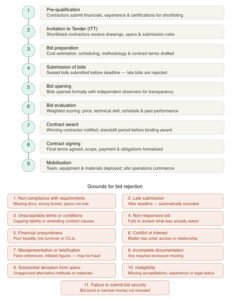
The Nine Stages of the Tendering Process
Construction tendering follows a carefully sequenced path. Each stage serves a specific gatekeeping or information-sharing function, and skipping or mishandling any one of them can derail a project before a single shovel breaks ground.
| 1 |
Pre-Qualification Before any tender documents change hands, clients invite interested contractors to demonstrate that they are worthy of being considered at all. Submissions at this stage typically include financial accounts, company references, proof of relevant certifications, insurance certificates, and a portfolio of comparable completed projects. The goal is to produce a vetted shortlist — eliminating under-resourced or inexperienced firms before the costly bid preparation phase begins. Both parties benefit: clients reduce risk, and shortlisted contractors face fewer competitors. |
| 2 |
Invitation to Tender (ITT) Once the shortlist is confirmed, each selected contractor receives a formal Invitation to Tender. This package is the blueprint for the entire bid: it contains project drawings, specifications, bills of quantities, proposed contract conditions, programme requirements, and detailed instructions on how and when to submit. A well-drafted ITT is the client’s single most important document — ambiguities here translate directly into costly disputes later. All tenderers receive identical information to ensure a level playing field. |
| 3 |
Bid Preparation With the ITT in hand, contractors enter their most intensive phase. Estimators price every element of the works. Programme managers build a delivery schedule. Technical teams draft proposed methodologies, risk registers, and health and safety plans. Senior management may review proposed contract terms and decide which commercial risks to accept or qualify. This stage demands close collaboration across disciplines — a rushed or poorly coordinated bid almost always shows, and rarely wins. |
| 4 |
Submission of Bids Completed bids are submitted by the specified deadline, usually in sealed envelopes or via a secure online portal, to preserve confidentiality and prevent any contractor gaining an unfair advantage. Deadlines are enforced strictly. In most public and regulated private procurement frameworks, late submissions are automatically excluded — no exceptions, no extensions, regardless of the reason. Contractors must build in time for final checks, printing, and delivery well before the closing time. |
| 5 |
Bid Opening Once the submission window closes, bids are formally opened in a controlled setting. Client representatives — and often an independent observer — are present to verify that the process is conducted transparently and that the seals have not been tampered with. In public sector procurement, the names of bidders and their headline prices are frequently recorded in an opening register, providing a clear audit trail. This ceremony is a cornerstone of procurement integrity. |
| 6 |
Bid Evaluation Evaluation is rarely a simple race to the lowest price. Modern procurement uses weighted scoring matrices that assign relative importance to criteria such as technical competence, proposed programme, supply chain resilience, sustainability credentials, past performance, and price. Evaluators score each submission against these criteria, sometimes conducting clarification interviews with shortlisted bidders. The weighting framework — agreed before bids are opened — prevents bias and ensures the decision can be defended to stakeholders and auditors alike. |
| 7 |
Contract Award The client notifies the preferred contractor of its intention to award. In regulated procurement, all unsuccessful tenderers are also notified simultaneously, along with their scores relative to the winner. A standstill period may apply — giving unsuccessful bidders time to seek clarification or, in some cases, to challenge the decision — before the award becomes legally binding. Only after this period does the client formally award the contract. |
| 8 |
Contract Signing With award confirmed, both parties work through any final negotiation of terms — particularly around risk allocation, payment mechanisms, and programme milestones — before executing the contract. The signed contract is the legal foundation of the entire project relationship. It defines scope, responsibilities, dispute resolution procedures, insurance requirements, and what happens if either party fails to meet their obligations. Rushing or glossing over this document creates problems that can take years to resolve. |
| 9 |
Mobilisation The contract is signed — now the real work begins. Mobilisation covers everything needed to move from a document to a functioning site: recruiting and briefing the project team, procuring long-lead materials, establishing site compound facilities, notifying the Health and Safety Executive where required, and submitting the detailed construction phase plan. A structured mobilisation period is essential; a scrambled or unprepared site start undermines client confidence from day one and often triggers programme delays that are difficult to recover. |
• • •
Why Bids Get Rejected: Eleven Critical Grounds
Preparing a high-quality bid requires significant investment of time and resource. Yet bids are frequently eliminated for reasons that have nothing to do with price or technical ability — administrative failures and compliance shortfalls that could easily have been avoided. Understanding the grounds for rejection is the first step to avoiding them.
|
1
|
Non-compliance with tender requirements Missing documents, unsigned declarations, forms completed in the wrong format, or failure to meet technical specifications all constitute non-compliance. Evaluators are rarely empowered to overlook these — doing so would be unfair to bidders who did comply. |
|
2
|
Late submission Deadlines exist to protect the integrity of the process. Bids arriving even minutes after the closing time are typically excluded outright. Force majeure clauses may apply in extraordinary circumstances, but these are narrowly interpreted. Plan for your submission to arrive at least 24 hours early. |
|
3
|
Unacceptable terms or conditions Bidders sometimes attempt to substantially amend the client’s proposed contract — capping liability well below the contract value, removing key obligations, or introducing unfamiliar sub-contract terms. Unless the ITT explicitly invited alternative contract proposals, such qualifications are likely to trigger rejection. |
|
4
|
Non-responsive bid If a submission fails to address the specific questions asked — or answers different questions entirely — it cannot be fairly evaluated against compliant bids. A bid that does not respond directly to the tender is treated as non-responsive. |
|
5
|
Financial unsoundness Contractors must demonstrate sufficient financial strength to carry the project through to completion. If audited accounts reveal inadequate turnover, poor liquidity, or a recent County Court Judgement, the bid will not pass financial pre-qualification thresholds — however competitive the price. |
|
6
|
Conflict of interest A bidder who has had advance access to commercially sensitive information — or who has a material relationship with a member of the client’s evaluation team — may be excluded to protect the fairness of the process. Clients take this seriously; the reputational risk of a tainted award far outweighs the inconvenience of exclusion. |
|
7
|
Misrepresentation or falsification Providing false references, inflating turnover figures, listing non-existent accreditations, or misrepresenting project experience constitutes fraud. Beyond rejection, contractors face potential legal action and permanent blacklisting from future tenders. The risk is categorically not worth taking. |
|
8
|
Incomplete documentation The ITT will specify a precise list of required enclosures — insurance certificates, method statements, CVs for named personnel, environmental policy, equality policy, and so on. A submission that omits even one required document is often rejected without reference to its price or technical quality. |
|
9
|
Substantial deviation from specifications Proposing a fundamentally different construction approach, alternative materials, or a significantly extended programme — without the client’s prior agreement — places the bid outside the scope of what was tendered. It cannot be evaluated on a like-for-like basis and is likely to be excluded. |
|
10
|
Ineligibility Many tenders specify minimum criteria: years of relevant experience, mandatory accreditations (ISO 9001, ISO 45001, Constructionline Gold, and similar), geographic restrictions, or a requirement to be registered in a particular jurisdiction. Bids from ineligible contractors cannot proceed, regardless of price or quality. |
|
11
|
Failure to submit bid security Where the ITT requires a bid bond or earnest money deposit — as is common in large infrastructure and international projects — failure to include this security will result in automatic exclusion. Bid security demonstrates the contractor’s commitment and protects the client if the preferred bidder later withdraws. |
• • •
The Bigger Picture
The tendering process is not merely administrative procedure — it is the mechanism through which clients exercise stewardship over public or private funds, and through which the construction industry allocates work to those best placed to deliver it. When the process works well, it produces fair outcomes: capable contractors win on merit, projects are delivered efficiently, and public trust in procurement is maintained.
For contractors, every stage of the tendering process is an opportunity to demonstrate quality, reliability, and professionalism — long before a single brick is laid. The discipline that goes into a well-prepared bid is, in many ways, the first proof that a contractor can manage a complex project.
For clients, a rigorous tendering framework is not bureaucratic excess — it is risk management. The weeks spent on pre-qualification, evaluation, and negotiation are an investment that pays dividends throughout the life of the contract.
A process built on transparency
Every stage of the tendering framework — from pre-qualification to contract signing — exists to serve a single principle: that the right contractor wins the right project for the right reasons. Understand the process, respect its requirements, and preparation becomes your greatest competitive advantage.